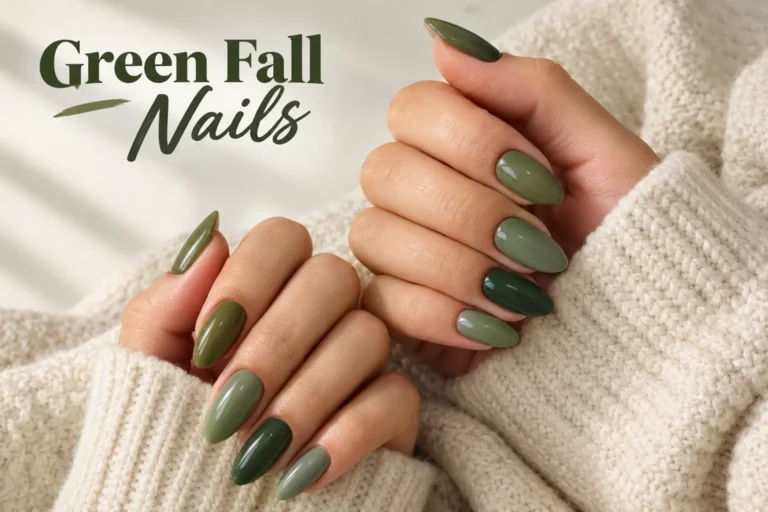

“Light green” gets treated like one shade, but it’s really a whole spectrum: sage, mint, celadon, pistachio, each pulling toward a different base. Some lean yellow, some lean blue, and that undertone decides whether a color reads soft and pretty on you or flat and a little off.
Skin tone matters here more than most people expect, and it’s the reason the same bottle can look completely different on two hands. Below are ten ways to wear this pastel that actually account for that, not just ten pictures of “pretty green nails.”
If you’re just browsing for inspiration beyond green tones, NailCraftly has a wider mix of colors and finishes to dig through.
Sage Green with a Warm Yellow Base

This Sage sits on the yellow side of the green family, which makes it forgiving on warm and olive undertones since it echoes the same warmth already in the skin. On cooler, pinker skin it can occasionally look a touch dusty, though a slight shimmer fixes that instantly.
A single thin coat often looks streaky at this opacity level, so plan on two full coats plus a cap coat for even coverage.
If you want to see how sage compares to richer, more saturated greens, our green nail ideas roundup lays out the darker end of the spectrum.
Celadon Blue-Green for Cool Undertones

This Celadon pulls noticeably blue compared to sage, which makes it one of the better light greens for cool or pink-based skin since it doesn’t compete with the pink already present. On very warm undertones it can occasionally look slightly clinical, almost hospital-adjacent, so a warm-toned base coat underneath softens that edge.
From the chair, this is one of those pigments where formula opacity really shows: cheaper polishes lay down chalky and uneven, while a good gel base holds the pigment consistently across all ten nails instead of going patchy on the thumbs.
Pistachio with Fine Gold Shimmer

This is warmer and slightly more muted than sage, closer to a greige-green, and it flatters a wide range of tones because it’s not fighting any particular undertone. A crème finish in this exact shade can read flat or chalky under office lighting, but adding even a whisper of gold micro-shimmer keeps it from going lifeless and pale.
This is a common mistake worth flagging: picking a pistachio swatch off a color card without checking it against your actual hand in daylight, since pastel pigments shift more than bold colors once they’re applied.
Milky Mint Base for a Soft, Translucent Look

A sheer, milky mint base sits somewhere between a nude and a color, letting a hint of green show through rather than covering the nail completely. This suits almost any undertone precisely because it’s translucent, so your natural nail bed does most of the color work and the pastel just tints it.
The honest trade-off is that these sheer, jelly-style formulas show ridges and imperfections more than an opaque polish would, so a ridge-filling base coat underneath makes a real difference.
Readers who like this translucent effect might also want our milky nail ideas collection, which has more of these soft, barely-there bases.
Cool Mint with a Glass-Like Jelly Finish

True mint leans blue-green and can look almost white under bright, cool indoor lighting, then read far more clearly green the moment you step outside. A jelly finish exaggerates this shift since jelly polishes are inherently more light-reactive than crèmes, letting more ambient light bounce through the color.
Three thin coats is usually the sweet spot for jelly-style greens; two leaves visible patchiness near the cuticle line, since pastel pigments carry less opacity than deeper polish colors.
Pale Sage Paired with Warm Terracotta for Summer

Sage doesn’t have to stand alone. Paired with a warm terracotta or rust on an accent nail, the yellow undertone in sage bridges the two colors instead of clashing with them, which is why this combination photographs so well in daylight.
It’s a pairing that leans into warmer months without tipping into anything too saturated or loud.
For more seasonal pairings built around lighter palettes like this, check our summer nail ideas for additional combinations.
Blue-Green Celadon with a Single Metallic Line

Keeping celadon as the base and adding one thin gold or silver line near the cuticle turns a simple pastel into something a little more considered without adding a second full color. Cool undertones benefit most here since the metallic warms the overall look just enough to keep it from reading sterile.
Technically, this only works well if the base coat has fully cured or dried first, since a wet base will drag the metallic line and blur its edge.
Solid Pistachio, One Coat of Nothing Else

Sometimes the most flattering option is also the simplest: pistachio on its own, no accents, no shimmer, just clean and consistent across all ten nails. This works because pistachio’s muted warmth doesn’t demand embellishment to look intentional, unlike some of the icier blue-greens that can look unfinished without something added.
If a single, quiet color is the whole point for you, our minimalist nail ideas page has more single-shade looks worth browsing.
Sage and Pastel Formula Behavior Compared

Sage, being warmer, tends to apply more evenly than its blue-toned cousins because yellow-based pigments generally have slightly better opacity at pastel concentrations. Mint and celadon, by contrast, often need that third coat we mentioned earlier to avoid a translucent, uneven finish.
Anyone curious about how pastel formulas behave more broadly, not just in green, will find useful comparisons in our pastel nail ideas guide, which covers finish and opacity across the whole pastel family.
Deep Olive-Adjacent Sage for a Muted Statement

Not every light green needs to stay pale. A slightly deeper, more olive-leaning sage still reads as part of the light green family but carries more visual weight, which suits warm and deeper skin tones especially well since it doesn’t wash out against more pigment in the skin.
Gel formulas hold this particular tone more evenly across multiple coats than standard lacquer does, which matters because a muddy, streaky olive loses the whole point of the shade.
It’s a good middle ground for anyone who wants green without committing to something as pale as mint or celadon.
Testing Before You Commit
Before settling on any of these, hold the actual polish bottle or a painted swatch against your hand near a window, not under bathroom or overhead lighting. Pastels shift more under artificial light than bold, saturated colors do, and a green that looks perfect under a salon’s fluorescent bulbs can look noticeably different by the time you’re outside.
A few minutes checking daylight can save you from redoing a full manicure because the undertone didn’t do what you expected once you left the chair.